



The Bay Area is fruitful hunting ground for mushrooms.
What could be more irresistible than a chance to forage for wild mushrooms, those gorgeous gifts of nature, while not dying of mushroom poisoning or ending up on the liver transplant list? The lure of life and death, in a single bite! But mushroom hunting is not supposed to be Russian roulette, nor a sport for the foolhardy. So what is a spore-seeking amateur to do?
In Northern California, opportunity abounds for foragers of all ages and knowledge levels to take advantage of two main factors. One is geographic. Thanks to an abundance of open space, from parks to canyons to forests, and thanks to an abundance of mushroom-loving trees, including oaks, pines, and madrones, many hundreds of mushroom species are ripe for the picking (or at least peeking). To that natural abundance add the largely suburban phenomenon of extensive landscaping. Did you know those damp piles of wood chips can be perfect mushroom breeding grounds? The Johnny Mushroomspores among us toss old mushrooms into the wood chips, and return later to see what’s up.
The second main factor is human. The greater Bay Area is home to a remarkable cohort of experts, not least of whom are Berkeley professors. The legendary David Arora, author of Mushrooms Demystified (“The Bible,” as one mycologist whispered to me, pulling her well-thumbed copy from her backpack) lives within foray distance. The Bay Area is also home to a basketful of mycological organizations welcoming to beginners. Most touted are the Bay Area Mycological Society, the Fungus Federation of Santa Cruz, the Mycological Society of San Francisco, and the Sonoma County Mycological Association (SOMA). Many of these groups hold informational and foraging expeditions.
The best times to go mushroom hunting in California are during breaks in a wet season, when rains have primed the soil for mushrooms. Incidentally, the part of the mushroom that you see (and eat) is only the fruiting body. These produce spores, which are dispersed by various means, including the mushroom hunters themselves (baskets are traditionally used for mushroom expeditions because the eyelets offer the chance for spores to escape). Spores produce the mycelium, a network of threadlike growth, which remains in the soil to sprout more mushrooms. Mycelia can persist for years, even millennia—the oldest one known, located in Oregon, may be 8,650 years old and is spread over 2,200 acres.
Because my own experience was limited to a few forays with people I trusted, I decided to attend the annual SOMA camp, held every January in the wooded hills outside the town of Occidental. SOMA’s “items to bring” list included standard fare for sharing a cabin and bath house with others (bedding, flashlight, towel, toiletries, etc.), but the “optional” items were less common: prong truffle rake or small garden claw, mushroom probing stick, compass, your favorite whistle, and a handheld multichannel radio “if you have one.”
In addition to being on the alert not to poison oneself, either by ingestion (you should never eat a mushroom that hasn’t been identified by an expert or that you haven’t been trained in identifying, beyond any doubt, yourself) or by wandering into poison oak (we got a brochure about that), a mushroomer must also be on the alert not to get lost. When one’s eye is on the prize, losing sense of direction is easy, even in familiar locations. I packed my favorite whistle.
This year, the entire SOMA camp was sold out, with some 250 participants ranging in age from children to the well-grizzled. Because 55 events were offered, several simultaneously, it was up to each attendee to choose among the crafty (Papermaking Using Mushrooms, Mushroom Dyeing), the scenic (Mushroom Hunting in the Sierra Nevada), the physical (taking a guided foray), the mycologically sophisticated (Fungal Genetics for Fun), or all the above.
One attraction of SOMA camp was that expert mycologists, including three from Berkeley, would be teaching. I made a newbie mistake of attending a lecture by the enthusiastic Dr. Todd Osmundson, a postdoctoral researcher at Berkeley’s Department of Environmental Science, Policy & Management. His topic, “Bolete genera,” had many heads nodding in appreciation, but was above one head (mine) unfamiliar with resupinate crusts and macrochemical field tests—not to mention Latin and Greek terminology. I did comprehend that one kind of bolete is the dry-rot fungus.
Other classroom teachers clearly made extra efforts to appeal to the non-Latin-spouting, case in point Else Vellinga, a senior museum scientist at the University and Jepson Herbaria at Berkeley. Her PowerPoint presentation on white-spored gilled mushrooms was funny and informative, using body types of characters from the French Astérix cartoon series as fungal counterparts. She pointed out that one unfortunate mushroom has a “boring spore pattern” under the microscope. We laughed.
For me, forays were more comprehensible. During my first, led by Ken Litchfield, who teaches mushroom cultivation at Merritt College in Oakland, we learned how the mycelium interacts with tree root systems, both nourishing each other symbiotically. Litchfield was a careful teacher, introducing beginners to such phenomena as turkey tail, that well-named fan-shaped growth commonly called “the chewing gum of the woods.” With his encouragement, I tore off a piece and gnawed. Like mushroom-flavored cardboard; still, not bad.
Truffle foray leader and Petaluma science teacher Darvin DeShazer on his sortie jokingly dissed redwoods—Let’s cut them all down!—for not harboring truffles. Then he taught us which trees to look under for them, how to rake carefully, and how to identify possible treasures by looking for at least three ice-cream-cone-shaped holes close together. The holes’ close proximity indicates they are connected by an underground mycelial mat that supplies nutrients from which the truffles form. It also indicates that other truffle lovers, such as the northern flying squirrel and the California red-backed vole, may have feasted on some ripe truffles before you got there. But more may be fruiting. DeShazer adds, “The only sure method for good pickings is a dog trained to find them as they ripen up.”
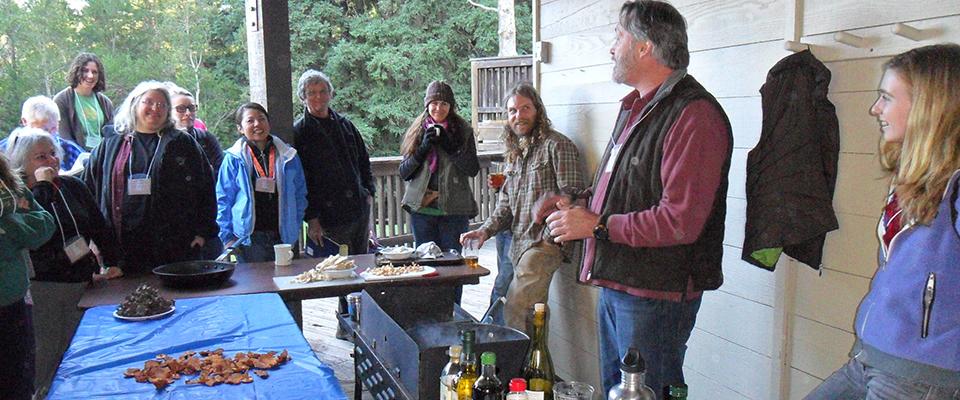
Throughout the weekend, foragers brought back examples of what they found, depositing them on paper plates for experts to scrutinize. Once the mycologists identified a species by eye, microscope, or spore print, it was labeled and placed on a viewing table under its proper genus. The haul from the forays yielded 222 species identified and photographed—not the highest number, due to a dry cold spell in previous weeks, said the experts, but it was enough to impress me. My finds included a splendid Peziza. I also harvested some exuberant Pleurotus ostreatus, aka oyster mushrooms. They were delicious sautéed at home and, I’d learned by then at another SOMA lecture, are a good anticholesterol medicine full of fiber and minerals.
By night we feasted on, of course, mushrooms—various samples cooked up in a class called Chef Demo. We were also treated to a cheese display, and hundreds of bottles of wine contributed by 19 wineries. Two kegs of beer appeared as well, and there was a rumored adventure with one camper’s homemade mead.
Even table talk was a learning experience. At one meal, an expert on the medicinal aspects of mushrooms told me that shitakes help fight cancer and hepatitis. Those chewy turkey tails, apart from their own medicinal qualities, make good soup stock when boiled, he said. And he was not alone in declaring that most mushrooms, including supermarket whites, should be cooked. One reason is that unless cooked, the cell walls’ mycochitin or chitin (related to the shells of crustaceans, for example), are mostly indigestible to humans. Another reason is that cooking releases the mushrooms’ nutrients. Another? Cooking generally destroys toxins.
Because I was more foray than classroom inclined, I missed talks such as Mushrooms Under the Microscope, Fungi Farmaceuticals, An Update on Newly Described Mushroom Poisoning Syndromes, The North American Mycoflora Project (taught by Cal’s Dr. Tom Bruns), Lichen Dyes, and (sigh) The Mushroom-Love Connection.
I later learned about a “mycoblitz” conducted at Point Reyes by the Bay Area Mycological Society, and about lectures sponsored by local mycological groups for, at most, a nominal fee. So many mushrooms, so much to learn.
But there’s always next mycelium.