




Early earthquake warning app works on people’s need-to-know
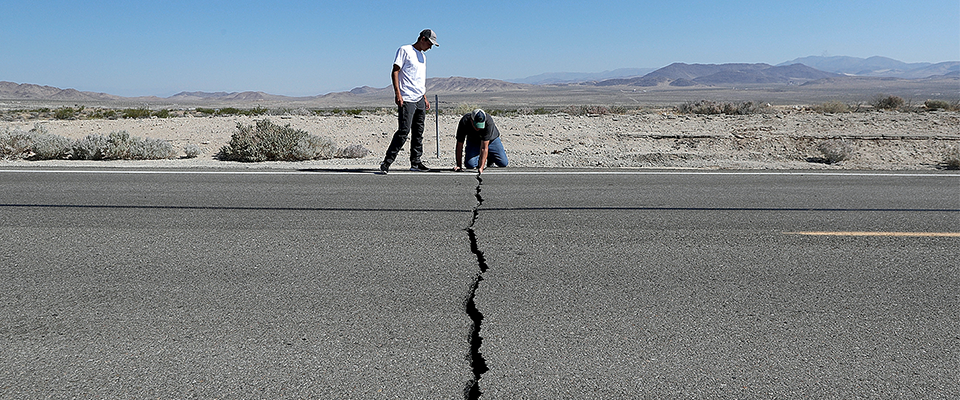
When a series of earthquakes rolled through the Mojave Desert over Independence Day weekend, the 500,000 Angelenos who’d downloaded the mobile app ShakeAlertLA thought they’d receive advance warning. Notification never came. Left to their own (silent) devices, many expressed frustration: Had the United States’ new earthquake early warning system, co-piloted by UC Berkeley researchers, failed its first major trial?
Multiple outlets reported that the system had worked, but the notification threshold on the app had been set too high. That’s not the whole story. According to the Berkeley Seismological Lab’s own blog, Angelenos didn’t get a notification because the network of sensors around the quake failed to accurately measure its intensity.
“You have to get people the information they need and not overwhelm them with information they don’t need.”
“The warning algorithms underestimated the magnitude of the quake by 0.8 magnitude units,” a researcher wrote. ShakeAlert clocked the earthquake’s initial magnitude at a 6.3 when in fact, it was a 7.1. If the sensors had measured correctly, the app would have generated a warning, and people downtown would have had a significant 49 seconds to prepare.
Berkeley seismologist Jennifer Strauss said that, moving forward, initial magnitude calculations could be improved with the addition of more sensors near powder-keg faults like the Hayward and San Andreas.
“Our network is not fully built out,” said Strauss, a regional coordinator for ShakeAlert. The early warning system currently operates with the minimum number of stations it needs to function—1,100—when 1,600 would be optimal. “If we have more stations to recognize the event, we get more data, and more accurate readings.”
Improving the accuracy of the system will be a people-powered effort. The Seismological Lab is asking property owners across the West to host earthquake sensors on their land.
As for lowering the notification threshold, Strauss is cautious: “You have to get people the information they need and not overwhelm them with information they don’t need.”
While ShakeAlertLA was designed to warn people of impending personal danger or structural damage, its first major trial suggested something else. People want to know when their nerves will be rattled, not just their buildings.