




Climate change and elephant hierarchies
When groups of hungry De Brazza’s monkeys were recently found wandering in Kenya’s arid north—thousands of miles from the swampy Congo Basin forests they usually inhabit—scientists had tangible evidence of the impact of climate change on the way species use their environment. Now, African elephants, too, are being forced to adopt new territories, but their migration is complicated by previously little-understood social hierarchies.
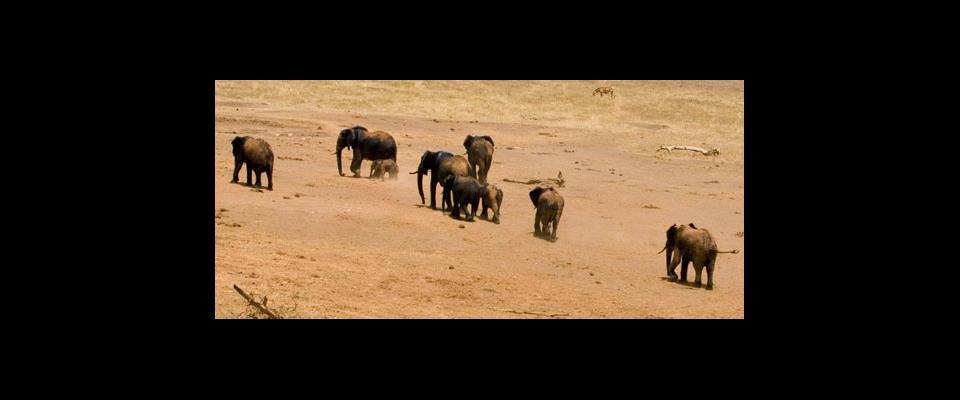
How elephants move around and use an area has as much to do with social rank as it does with resource availability, says George Wittemyer, Ph.D. ’05, a postdoctoral researcher with Berkeley’s department of Environmental Science, Policy, and Management. For the past ten years, Wittemyer has worked with the nonprofit Save the Elephants Trust, studying elephants in the Samburu region of Kenya. Using GPS radio collars, he tracked seven elephant families and found that during the dry season, when resources are scarce, the groups led by dominant matriarchs traveled just 4–5 kilometers per day for food compared to the 8–11 kilometers traveled by low-ranking elephants. Furthermore, they stuck close to permanent water sources and in protected conservation areas, pushing out less dominant elephants.
These less dominant elephants then run a greater risk of attack by farmers who resent their prying trunks and trampling feet. “Relying on these small, well-protected areas is just not going to be sufficient in terms of allowing the animals to really deal with climate change,” says Wittemyer. “They need much larger, connected ecosystems to be able to move around and to change how they use resources as the climate changes.”