





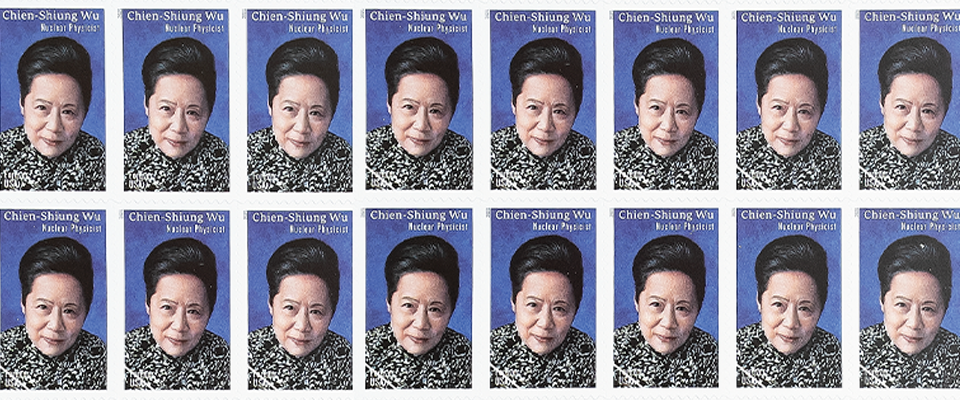
IN FEBRUARY, THE U.S. POSTAL SERVICE released a new Forever Stamp honoring the late Dr. Chien-Shiung Wu, one of the most influential nuclear physicists of her era.
Born in China in 1912, Wu came to America at age 24 and studied nuclear physics at Cal. As a graduate student, she worked at Berkeley’s Radiation Laboratory—now the Lawrence Berkeley National Lab—under Ernest O. Lawrence, for whom the lab was later renamed.
In 1944, Wu, like Nobel laureate and fellow Radiation Lab physicist Emilio Segrè, joined the Manhattan Project, where she helped develop the uranium enrichment process.
Nicknamed the “First Lady of Physics,” Wu is best known for her contribution to the discovery that parity is not conserved in weak nuclear interactions. Though it was her expertise that helped prove this hypothesis, Wu was not included when her male colleagues, Tsung-Dao Lee and Chen-Ning Yang, won the 1957 Nobel Prize in Physics for the discovery. Her role was finally acknowledged in 1978, when she was awarded the first-ever Wolf Prize.
During her decades-long career, Wu taught at Princeton and Columbia, developed improved Geiger counters, earned eight honorary degrees, received the National Medal of Science, and served as the first female president of the American Physical Society.
“When we think about the best of America, Wu comes to mind,” said Postal Service spokesperson Mauresa Pittman. The Chien-Shiung Wu Forever Stamp is now available for purchase online and at post offices nationwide.