



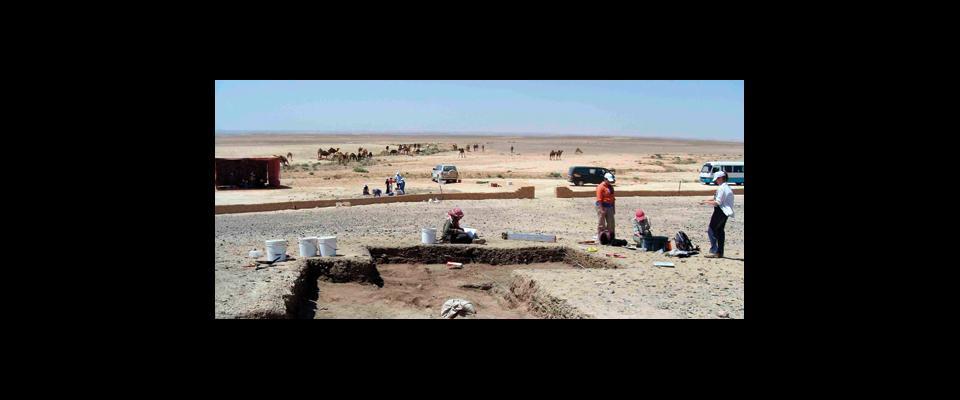
An archaeological dig in Jordan holds some of humanity’s oldest settlements.
It is hard to imagine the remote, desert region of eastern Jordan as a popular oasis, but that is exactly how Berkeley archeology professor Lisa Maher envisions it looked 20,000 years ago. “This area would have been a lush grassland with pistachio and almond trees, animals, plants, and nearby rivers and lakes,” she said. For the past six years, she has co-directed a team of researchers at the Jordanian excavation site Kharaneh IV. The settlement dates from 10,000–20,000 years ago and provides a rare glimpse into the lifestyle of early hunter-gatherers.
At 20,000 square meters, Kharaneh IV is the largest archaeological site of its kind. It also has the densest accumulation of artifacts, according to Maher. Her team’s research suggests that many social, economic, and ideological developments may have happened much earlier in human history than previously thought. “We are finding that people picked particular places in a landscape to settle and return to,” Maher said. “They were involved in elaborate, intricate, far-reaching social interactions.”
Among the finds were two huts that were clearly used as homes, as indicated by the type of debris found there. Additionally, plant and animal remains that could only have been available during certain seasons suggest the area was occupied year-round. “This is not to say people were there every day in a permanent settlement, but people repeatedly occupied this area,” said Maher. Maher’s team also found more than 1,000 shell beads, which may have been used for trade. Some of the shells came from the Indian Ocean, 2,000 kilometers away, a fact Maher finds “fascinating because either people were traveling long distances or they were involved in far-reaching exchange networks and interacting somewhere in the middle.”
Perhaps the greatest find, however, was two human skeletons, both adult men. Their interment was reminiscent of symbolic burials more common in people from the later, Neolithic period. One man had two large stones placed over his head and over his legs. Another stone, along with a part of a gazelle horn, lay near the skull of the second skeleton.
The team has only uncovered 100 square meters of the site and will need to discover more bodies to conclude that placement of these artifacts was in fact ritualized. Maher plans to spend the next several years focusing on this area. “Discovering the huts and skeletons underneath completely shook up our excavation,” Maher said. “Were these skeletons intentionally buried here? That’s our million-dollar question.”