




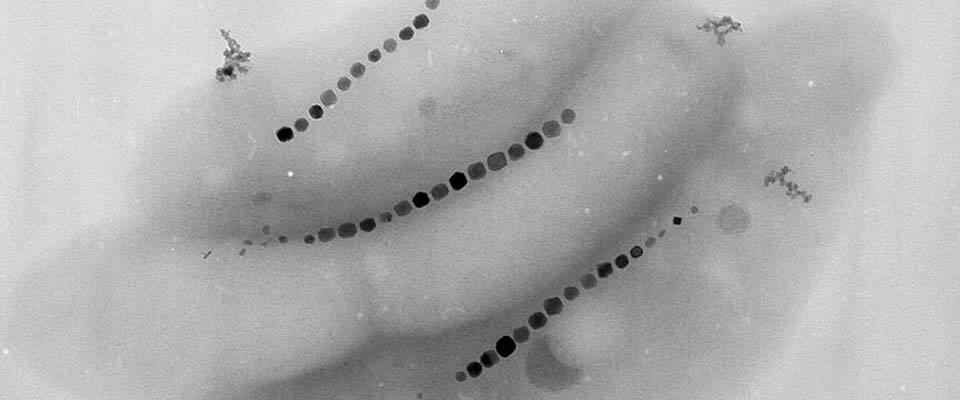
When we say “internal compass,” we’re usually referring to something metaphorical, a person’s innate sense of right and wrong. But for UC Berkeley microbiologists Arash Komeili and David Hershey, the term is literal: The two study magnetotactic bacteria, which navigate using tiny magnetic iron crystals called magnetosomes.
Such bacteria are ubiquitous in lakes, where their navigational equipment comes in handy: Instead of swimming haphazardly in circles, the bacteria use their magnetosomes to align with the Earth’s magnetic field, much as compass needles do. The orientation (northward but also slightly downward, at least in the Northern Hemisphere) helps the microorganisms seek just the right depth for ideal oxygen levels. (In the Southern Hemisphere, scientists have found South-seeking magnetotactic bacteria.)
Since these types of bacteria were first discovered in 1975, most researchers studied them with an eye to using their nanometer-scale crystals in biotech and nanotech applications. But Komeili and Hershey are more interested in the fundamental genetics of magnetosome formation. And last year, the two scientists made an important discovery toward figuring out exactly how the tiny organisms build their way-finding organelles.
One of the factors that this process hinges on is an enzyme called MamO, as the researchers detail in a PLOS Biology paper published in March. At some point in the distant past, it seems that MamO lost its ability to function like a normal enzyme and break down other proteins. The bacteria then repurposed MamO as a scaffold to connect iron atoms and assemble their compasses.
It’s a neat bit of molecular maneuvering, and by comparing genomes Komeili and Hershey found something even more surprising. All three of the bacteria’s major families arrived at the same mechanism, using the same defunct protein—independently. “That’s convergent evolution, and it suggests that something forced them to change the way they do things to this really bizarre way that we found,” says Hershey, a graduate student in Komeili’s lab.
That something is still unknown: maybe a sudden swing of oxygen levels in the water, or a change in the availability of different types of iron. Whatever the case, Komeili says, “The fact that this adaptation happened in all the different lines independent of each other showed that it was important” for that intricate magnetosome-building mechanism to function, “that without it, for whatever reason, they couldn’t get the system to work.”