





Eighty-six years ago, physicist Paul Dirac theorized the existence of magnetic monopoles; that is, magnet poles that exist independent of each other. Not north and south together. North. And south. Separately.
Nearly a century later, Felix Flicker, a Berkeley theoretical physicist and post-doctoral researcher in the lab of Norman Yao, is working to help prove Dirac’s theory. “There was this sort of philosophical point I was thinking of,” Flicker says. “You can’t have the left end of a stick without the right end, can you?”
Even when broken down to nanometer-sized particles, one fact remains about magnets: North and south poles are invariably found together. “A magnet is called a magnetic dipole,” Flicker explains. “As in, it’s got two poles, a north and a south,” which cannot be separated. As in a bar magnet. But, he goes on to explain, there is an electric dipole, which has “an electron and a positron” at opposite poles. As in a battery.
Finding magnetic monopoles would help physicists achieve a unified theory of the universe. “All the laws of nature would look a lot nicer if they did exist…. It’s just that we’ve never found the things.”
Why is this phenomenon considered an oddity of physics? “With the electric dipoles, you’re allowed to just pull them apart and you’ve got the two separate charges. For some reason in the magnetic case, you can’t pull them apart,” he says. “Why does it exist as a dipole and not as two monopoles?”
Electricity and magnetism are so closely related that electromagnetism—their interaction—is one of the four fundamental forces of our universe. The only dissimilarity between electricity and magnetism seems to be the existence of electric monopoles—commonly known as charged particles—and the absence of magnetic monopoles. Finding magnetic monopoles would reconcile the two and help physicists achieve a unified theory of the universe.
“All the laws of nature would look a lot nicer if they did exist…. It’s just that we’ve never found the things,” Flicker says.
Lab experiments have produced monopole-like structures, but so far, no one has seen anything more than a simulation. Now, though, with a new detector, ultracold temperatures, and a bit of luck, Flicker and his colleagues may finally be able to observe this phenomenon in a magnetic crystalline material called “spin ice.”
The spin ice in question, an intricate molecular lattice, is grown in Oxford and was sent to Harvard’s NV-magnetometer, one of the few devices equipped to handle the proposed experiment. Run by Harvard’s condensed matter physicist Amir Yacoby, the device has been created to withstand temperatures as cold as 1.5 kelvin, which is about –271.65 degrees Celsius—really, really cold.
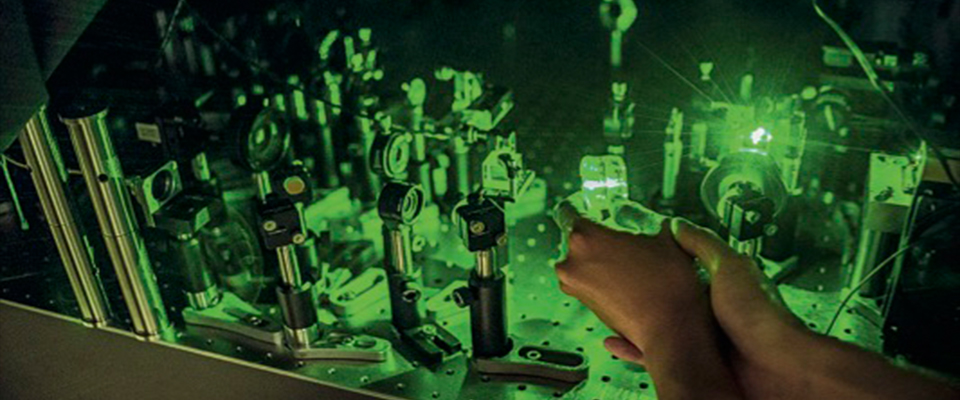
The NV-magnetometer relies on individual defects in diamond to scan magnetic fields; it will scan an area of spin ice 10 x 10 nanometers (1 nanometer = one-billionth of a meter) and, if all goes as planned, will record a magnetic monopole pass through in milliseconds.
Flicker says that, if successful, the findings will be the “smoking gun signature” for the magnetic monopole phenomenon. Though not an observation of a new fundamental particle predicted by Dirac, this may get as close to spotting one as scientists ever come.
Magnetic monopole particles are likely extremely rare; Flicker speculates there may be a single particle in every galaxy. In the case of Flicker’s experiment, this will not constitute the observation of a real particle.
“Whenever a particle is detected, it is interacting with the detection apparatus and therefore not fundamental in the strict sense. It’s a quasiparticle, in a loose sense of the word,” he explains. “Of course, we can infer the existence of fundamental particles even if we’ll never see them. Like inferring the existence of an objective universe, even though all our experiences of it are subjective.”
Practical uses of magnetic monopoles are tricky. As can often be the case with physics, not every discovery has a straightforward practical application. Flicker has a few speculations for monopole use: “magnetricity” and computer memory. If magnetic monopoles can wander through spin ice, then they may be able to flow like electrons in an electric current and be harnessed the same way we harness electricity. Magnetricity could potentially be used as a much more compact form of computer memory.
“But these are pretty early stages,” Flicker says. “We’ve got to prove this thing exists. Then hopefully people will get much more interested in trying to implement it in technology.”