






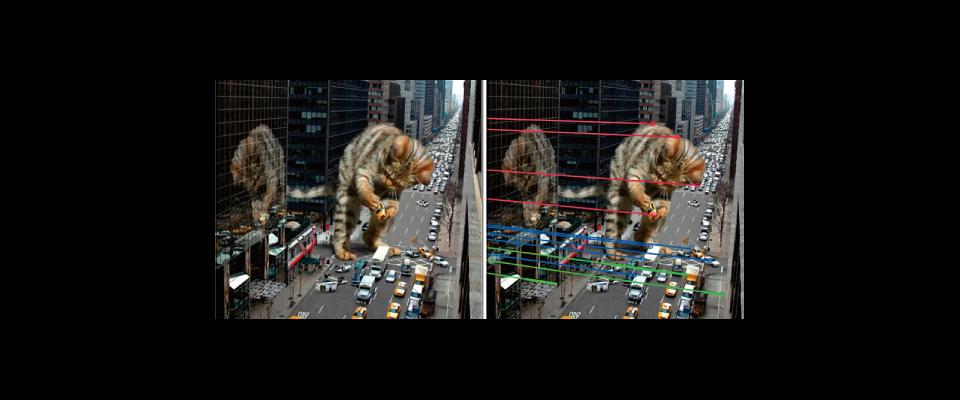
All fraudulent photos have their secrets. A Berkeley professor uses geometry to uncover them.
As digital imaging advances, an increasing number of manipulated photographs are finding their way into the lab, the courtroom, and the newsroom. But if those photos show objects and their reflections, Berkeley computer science professor James O’Brien and his colleague Hany Farid of Dartmouth say they can use geometry to separate the real from the fake.
When your reflection appears in a mirror, a body of water, or any other flat, smooth surface, certain geometric relationships have to hold. “Something that’s faked won’t necessarily follow these rules,” says O’Brien. Many of the researchers’ methods rely on finding new ways to apply age-old geometric principles. One of the simplest of these rules is the idea that the lines connecting parts of an object and their corresponding parts in the reflection, must converge at a single point. If they don’t, the picture cannot be legitimate.
O’Brien and Farid have also developed more complicated techniques using algorithms to locate points on the mirror surface and to find the camera position, called the center of projection. Altered photos, they demonstrated, often have points that seem out of place, or centers of projection that suggest the camera was in two places at once.
Unlike statistical methods that calculate the probability a photo is doctored, geometric methods provide definitive results—failing even one geometric test means that an image has been tampered with, according to O’Brien. However, passing every test doesn’t prove that an image is real, only that the tests couldn’t find anything wrong.
The wider impact of photo forensics, O’Brien says, is that it delves into how we relate to images. We trust what we see, and we’re easily fooled because our eyes can’t detect complex geometric relationships like the center of projection. But O’Brien says it’s better that way—if we could differentiate between subtle differences in viewing angles, we’d have a hard time watching movies at the theater. “The only seat that wouldn’t feel wrong would be the one spot right in the middle,” says O’Brien. “We would all fight over it and it wouldn’t work.”